What you’re looking at is more than a decaying old pier. It’s part of Aurora’s past, sitting beside the Willamette River for generations. Yet looking at submerged structures like this from the riverbank is akin to the limited prospects of an angler with no boat, given such limited access…if you can see much at all. But there’s something else hidden here. View the 1 minute preview by clicking the image immediately above.
What we uncovered early on borders on startling. That’s because Aurora’s Butteville Landing isn’t merely a dilapitated old dock. Instead, the State of Oregon has formally recorded it as archaeologically important, with a code all its own: 35MA394. In other words, the Butteville Landing is archaeologically documented as a significant historical site. View the full 9 minute video by clicking on the image above.
When we think about history, it’s easy to imagine museums, dusty books or old black and white photographs. Now imagine delving into a historical mystery…by going where others haven’t…and few have dared. So while books and museums give a limited view of the past, what if you could travel where our area’s history isn’t normally seen to examine what’s usually hidden? This brings us to Aurora’s historic Butteville Landing,…where much of our local history began.
While walking along Liberty Street in Aurora, Oregon…if you look a little to the east, you may notice a small forest of trees between you and the Pudding River. Today, you might hear songbirds and the rustle of Douglas firs. But in the Autumn of 1863, this exact stretch of woods was the site of a smoke-filled race against time. Because without what lay buried beneath these trees, the utopian dream of Aurora, Oregon, wouldn’t have just struggled… it would have stopped.
HIDING IN PLAIN SIGHT Most people pass by without a second glance. To be fair, it’s easy to miss, even for local residents. But below those trees was the key to unlock the region’s survival. And without it, Aurora may never have become the town we know today. Today, it’s obscured. But long ago, this area echoed with the sounds of axes, horses, shovels and the crackling of kilns.
This wasn’t just another worksite, either. It transformed Aurora into one of Oregon’s most noteworthy communities. And a case could be made that without this stretch of land, instead of a heartwarming story of community, the Aurora Colony might not have made it through the winter. To begin though…and like many mysteries…we start from the ground up.
When Dr. Wilhelm Keil brought his followers to the banks of the Pudding River in 1856, it was to become a communal society where everyone worked together. And there was plenty to be done. Yet their new homeland offered a lot to work with: Fertile soil…timber…rivers for water transport…and land routes connecting to nearby vital towns like Salem and Oregon City.
TROUBLE BREWING But Aurora’s Colonists had a big problem. Building a community requires building materials. Many think of Aurora as a town made with wood. Nearby forests supplied plenty of lumber, but wood alone couldn’t safely heat a home during long, bone-chilling Aurora winters. That’s because one thing Aurora didn’t have was brick. Without it, there were no proper chimneys, ovens, or home foundations. And with the onset of freezing weather, surviving Oregon’s Winter took a sudden and dramatic shift. New families were arriving, all needing a place to live. Along with homes, the Aurora Colony also needed stores, churches and a variety of other buildings. Someone had to make those bricks.
ONE MORE PROBLEM But there was another problem and that was the race against unforgiving, wet Oregon weather. If the Colony wanted brick, it would have to make its own before autumn rains turned everything to mud while families froze. Being industrious Germans, the colonists determined the answer wasn’t IN the soil. The answer WAS the soil.
That’s because around the Pudding River lay something invaluable: Clay soil. So arguably the most valuable natural resource around Aurora wasn’t timber. It was mud. Today, wet soil seemingly has no value. But to 1860’s Aurora Colonists, it was good as gold. But here’s the strange part. Today there’s almost nothing left to tell visitors that Aurora’s industrial heart once stood here.
The floodplain of the nearby Pudding River held those deposits. So to modern passersby…it looks like ordinary mud. Yet to an experienced brickmaker, it looked like opportunity. But it gets even better, because water from the Pudding River helped when mixing it and wood from surrounding forests fired the kiln. Then once those bricks cooled, they could be hauled a short distance into town where construction was booming and desperate for brick.
ONE REMAINING INGREDIENT Nearly everything needed for a brickyard existed here, long before the first colonists ever arrived. Except one thing― Making bricks isn’t like making mud pies, since dangerously high temperatures approaching several thousand degrees are needed. Otherwise the Pudding River clay shrank, cracked and exploded in fire if not tempered, molded and baked correctly. So clay alone wasn’t enough. The colony desperately needed someone with a very specific skill. That’s becauseclay is useless without mastery. So they needed a brickmason. But a single brickmason wouldn’t be enough. Given the scale of work to be done, that man would have to wear many hats in order to coordinate, lead and teach others.
As it turned out…one German immigrant possessed those exact skills. His name? John Will. In 1860’s Aurora, Oregon, Will was the right man for the job. That’s because as a professional stone brick-mason, John Will served as foreman of the Colony’s brickyard operations. In Aurora…his skills suddenly became indispensable as he oversaw one of the busiest construction periods in Aurora’s history, beginning soon upon his arrival. Will wasn’t just an expert mason—he oversaw an industrial scale operation.
Picture an early morning, with workers digging clay from the river, while others mix it with water to just the right consistency. Brick molds fill, one after another, as rows of fresh bricks dry in the sun.
BLISTERING HEAT Once temperatures approach 2,000 degrees…mud becomes brick. But miss that temperature…and days of work are wasted. The results of backbreaking labor could completely vanish if the temperature wasn’t closely monitored. Then finally…the hottest job of all…feeding the kiln. That kind of work would make working the fry vat at your local hamburger chain actually look inviting. For long periods the fires couldn’t be allowed to die, because like Goldilocks, too cool…and the bricks would crumble. Too hot…and they could warp or crack.
It was dirty and relentless skilled work, with each brick produced making a family warmer. A byproduct of all this labor was the human connection sought by the Colony’s founders. Sometimes friendship and neighborly love wasn’t demonstrated by a Sunday sermon, but from conversations beside a half-built fireplace while consoling a family experiencing hardship. Workers here carried skills with them that would leave a permanent mark on the town. And today visitors come to Aurora, admiring its historic homes, museum and antique shops. And though buildings frequently receive the attention, they were all made better with the unseen labor making the bricks.
Few realize deep in the ground, hidden behind the woods east of town lies the key that unlock Aurora’s growth. Those kilns have pretty much vanished into history and trees have reclaimed much of the land. So nature has quietly covered what people once worked so hard to create. But the story remains. Every brick laid into a chimney…every warm fireplace…every bakery oven that fed a growing community…began with clay beside the Pudding River. Today…birds sing where kilns crackled. Trees shade ground once scarred by shovels. Moss and ivy slowly cover what people built with blistered hands. But if you stand quietly and look around…you’re standing where Aurora was fired into existence. Sometimes history isn’t found inside museums. Sometimes it starts in the most ignoble place of all, beneath your feet.
Aurora didn’t simply rise from the forest, but from nearby mud along the Pudding River. And if you’ve ever wandered those quiet woods east of Liberty Street…you may have walked across the very ground where Aurora’s future was forged with trial by fire…one brick at a time.
Looking at Aurora, Oregon’s Willamette River railroad crossing today, it’s easy to think that when the railroad reached the river, they built a bridge. But the real engineering challenge began long before the water. That’s because the land beside the river was low and therefore prone to flooding. This meant a railroad could be washed away simply by rising water.
That was major problem #1 and this meant the stretch of land between Aurora and Wilsonville was unsuitable for a railroad. Yet it gets worse, because here’s the thing: The Willamette crossing at Aurora wasn’t simply about crossing the Willamette River. The real challenge was getting trains up, over, and back down. That was major problem #2. So how are you going to address both of these mammoth and seemingly intractable issues? Click on the video to find out in Part 2 of this interesting series.
It’s a story with all the workings of a well hidden caper. That’s because under the cover of night, this true event featured an elaborate undercover operation…with a secret hideout near Boones Ferry Road on the outskirts of Aurora, Oregon, including a unique transportation hub to evade detection. The stakes are also high and law enforcement is hot on the heels of criminals and actively working to track them down. Except this is one story you’ve never heard before.
TheSetting: 1930’s Aurora, Oregon It’s the evening of October 3, 1936 and federal authorities are readying a criminal takedown. But this isn’t a misdemeanor sting on a few two bit punks. The men on these outskirts of Aurora, Oregon, are smugglers, with their center of operation a short strip of land between current day Charbonneau and nearby Boones Ferry Landing. It’s the length of maybe a few football fields. From there, they move their contraband across the Willamette River, north to Wilsonville and on to greater Portland.
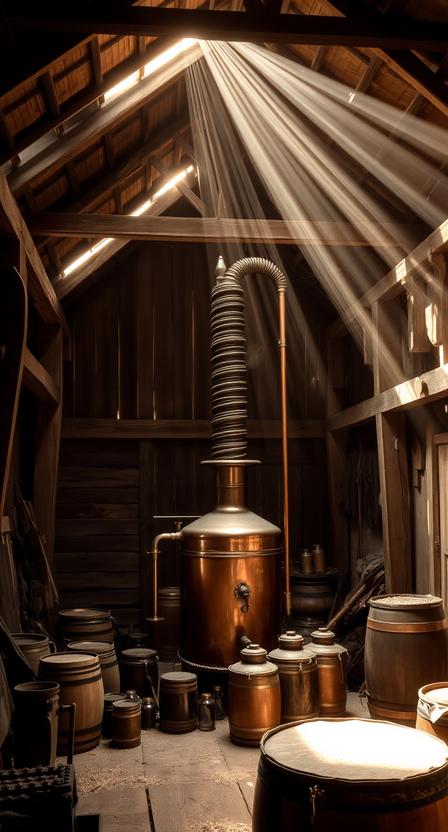
Law Enforcement: On The Case The information given to law enforcement involves a liquor distillery on the periphery of Aurora, with that liquor traveling across the Willamette River to Wilsonville. With this tip, officers begin their surveillance from the Wilsonville side of the river. Their surveillance pays off big-time, as the lawmen notice a heavily loaded truck cross the ferry to Aurora’s backyard known as French Prairie on the north end of Oregon’s Willamette Valley.
French Prairie Located south of the Willamette River, the area was settled in the 1800’s by French-Canadian frontiersmen and trappers. It became a strategic crossroad for smuggling contraband. That’s because roads and rivers have long been plentiful around Aurora. The old Pacific Highway — now called Highway 99E — passes through town, connecting Portland to Salem. Boones Ferry Road has also long connected both of those major cities. As for waterways, both the Pudding and Willamette rivers meander past Aurora. Each route gives moonshiners options to evade government detection. For lawmen trying to intercept illegal hooch, it becomes a ‘cat and mouse’ game.
Getting the Lay of the Land After a few nights of watching, law enforcement spots the same truck again crossing from Wilsonville on Boones Ferry Road. It then takes Boones Ferry across the Willamette River. Officials follow it to the old Wagner farm, now part of present day Charbonneau, but then the site of a distillery and storage facility.
Hide & Seek As officers watch from a nearby field, one early distillery giveaway is the smell of fermenting mash. Sounds emanating from a water pump also revealed what was for that time a state-of-the-art mechanized well. Law enforcement then observes trucks leaving with lights off. It’s then a short drive from the distillery to Boones Ferry Landing, then across the Willamette River, back to Boones Ferry Road on the Wilsonville side and north to Portland. Minimal road exposure means little risk of being spotted by passing lawmen on a main highway. And by operating without lights, it’s clear the smugglers know their way around…even in the dark.
Secret Sauce Over multiple nights, officers observe even more heavily loaded trucks, plus a car driving in and out of the Wagner farm property. Further surveillance finds men unloading bulky items at the distillery, then loading what appear to be containers of liquor. The crooks are clever to avoid detection on the road…and in hiding their distillery, too. That’s because their distillery is located within a separate enclosure, surrounded by a high fence of chicken wire. It also has an early warning system, plus a yard gate, approachable only through the Wagner residence.
Law Enforcement Takedown Fast forward To the night of October 3,1936, when just before the bust, federal officials hear the perpetrators comment “We’ll run the mash tomorrow night,” with mash a key ingredient for making moonshine liquor. One officer then notices a still and related paraphernalia, including an industrial size 25 pound package of yeast, another component of home brewing. But to these federal officials, most noteworthy is the bottle containing an amber colored fluid, classic for whiskey, with no revenue stamps attached. This is the felony act.The entire operation is soon disrupted for good. Federal agents move in with their raid when one defendant walks out of the building to retrieve yeast, returns to the building and is arrested while entering his car. Several other men on the Wagner farm are then arrested.
White Lightning What’s significant isn’t so much that this arrest happened, but WHEN. That’s because it occurred AFTER Prohibition, once alcohol use had again been legalized. That irony is deep as the nearby Willamette River. So what gives? One word: Taxes. So the men running liquor through the hinterlands of Aurora weren’t violating Prohibition laws. Instead, given their possession of four gallons of moonshine whiskey, they were violating federal tax law, the liquor tax act. The actual charge was the removal, concealment and transportation of non-tax paid liquor, the same kind of federal tax beef that sealed mafia kingpin Al Capone’s fate when government couldn’t make his other mob-related charges stick.
Prohibition Over The case is decided years after Prohibition’s 1933 repeal. By then, the public had largely moved on from arguments about alcohol. Bootlegging arrests began as front-page news during the 1920’s, because that was part of a national discussion on Prohibition. Yet by 1937, that argument was settled. This meant that a moonshine bust around Aurora was now more of a tax evasion case, not a referendum on drinking alcohol.
What Happened To The Distilling Defendants? District Judge James Fee renders his decision on March 22, 1937, giving the ringleader four years of hard labor at McNeil Penitentiary in Washington State. His associates were given lesser sentences and the farmowner received a suspended sentence, but required to pay a hefty fine for the unpaid tax value of all the liquor accounted for.
Sentence Appealed The main character’s four year sentence is later appealed on Fourth Amendment grounds about unwarranted search and seizure, but that challenge fails, finding officials had sufficient probable cause for search and seizure of alcohol without the payment of required federal tax. History lives on. That’s because the Wagner farm was later annexed into Wilsonville’s Charbonneau neighborhood on the Willamette River’s south bank. The district traces its name to Jean Baptiste Charbonneau, a son of Sacagawea who traveled with his mother on the Lewis and Clark Expedition as an infant.
The Site Today Even now you can observe an existing remnant at the center of this distillery drama near the former Wagner farm site. Passing through Charbonneau’s northern section on the appropriately named French Prairie Road, you’ll see a tall wooden structure. That’s the old Wagner farm well location, sitting on the same land where a hidden distillery operated behind a chicken wire fence, as trucks ran without lights on their way to Boones Ferry Landing…and where federal officers smelled fermenting mash, as they monitored the scene from a neighboring pasture. Ironically, those same grounds are now part of a posh golf community.
Part of that same Wagner farm was once owned by someone with a storied Boone connection, since it was once part of the Boone family’s long held land claim. So Chloe Boone, great granddaughter of Daniel Boone, married Oregon’s last territorial governor, George Curry. Part of that Curry House land later became the Wagner farm where the takedown occurred. So the next time you’re driving on the outskirts of Aurora near Charbonneau, consider taking a pleasant detour and observe what remains of this interesting local history. You can also learn about the origins of Aurora, Oregon’s historic Boones Ferry in the video below.