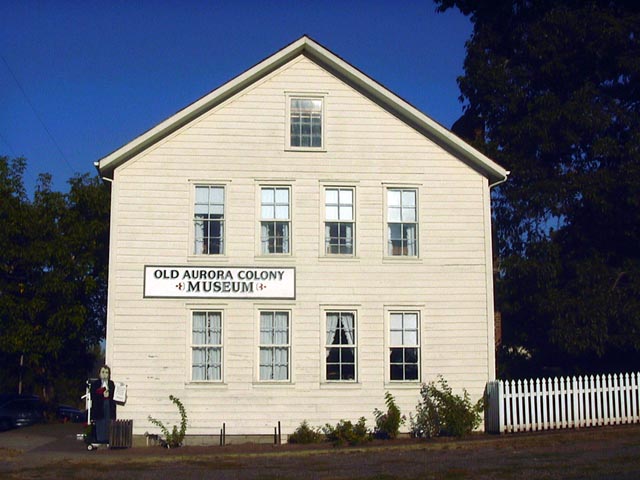
While walking along Liberty Street in Aurora, Oregon…if you look a little to the east, you may notice a small forest of trees between you and the Pudding River. Today, you might hear songbirds and the rustle of Douglas firs. But in the Autumn of 1863, this exact stretch of woods was the site of a smoke-filled race against time. Because without what lay buried beneath these trees, the utopian dream of Aurora, Oregon, wouldn’t have just struggled… it would have stopped.
HIDING IN PLAIN SIGHT
Most people pass by without a second glance. To be fair, it’s easy to miss, even for local residents. But below those trees was the key to unlock the region’s survival. And without it, Aurora may never have become the town we know today. Today, it’s obscured. But long ago, this area echoed with the sounds of axes, horses, shovels and the crackling of kilns.
This wasn’t just another worksite, either. It transformed Aurora into one of Oregon’s most noteworthy communities. And a case could be made that without this stretch of land, instead of a heartwarming story of community, the Aurora Colony might not have made it through the winter. To begin though…and like many mysteries…we start from the ground up.
When Dr. Wilhelm Keil brought his followers to the banks of the Pudding River in 1856, it was to become a communal society where everyone worked together. And there was plenty to be done. Yet their new homeland offered a lot to work with: Fertile soil…timber…rivers for water transport…and land routes connecting to nearby vital towns like Salem and Oregon City.
TROUBLE BREWING
But Aurora’s Colonists had a big problem. Building a community requires building materials. Many think of Aurora as a town made with wood. Nearby forests supplied plenty of lumber, but wood alone couldn’t safely heat a home during long, bone-chilling Aurora winters. That’s because one thing Aurora didn’t have was brick. Without it, there were no proper chimneys, ovens, or home foundations. And with the onset of freezing weather, surviving Oregon’s Winter took a sudden and dramatic shift. New families were arriving, all needing a place to live. Along with homes, the Aurora Colony also needed stores, churches and a variety of other buildings. Someone had to make those bricks.
ONE MORE PROBLEM
But there was another problem and that was the race against unforgiving, wet Oregon weather. If the Colony wanted brick, it would have to make its own before autumn rains turned everything to mud while families froze. Being industrious Germans, the colonists determined the answer wasn’t IN the soil. The answer WAS the soil.
That’s because around the Pudding River lay something invaluable: Clay soil. So arguably the most valuable natural resource around Aurora wasn’t timber. It was mud. Today, wet soil seemingly has no value. But to 1860’s Aurora Colonists, it was good as gold. But here’s the strange part. Today there’s almost nothing left to tell visitors that Aurora’s industrial heart once stood here.
The floodplain of the nearby Pudding River held those deposits. So to modern passersby…it looks like ordinary mud. Yet to an experienced brickmaker, it looked like opportunity. But it gets even better, because water from the Pudding River helped when mixing it and wood from surrounding forests fired the kiln. Then once those bricks cooled, they could be hauled a short distance into town where construction was booming and desperate for brick.
ONE REMAINING INGREDIENT
Nearly everything needed for a brickyard existed here, long before the first colonists ever arrived. Except one thing― Making bricks isn’t like making mud pies, since dangerously high temperatures approaching several thousand degrees are needed. Otherwise the Pudding River clay shrank, cracked and exploded in fire if not tempered, molded and baked correctly. So clay alone wasn’t enough. The colony desperately needed someone with a very specific skill. That’s because clay is useless without mastery. So they needed a brickmason. But a single brickmason wouldn’t be enough. Given the scale of work to be done, that man would have to wear many hats in order to coordinate, lead and teach others.
As it turned out…one German immigrant possessed those exact skills. His name? John Will. In 1860’s Aurora, Oregon, Will was the right man for the job. That’s because as a professional stone brick-mason, John Will served as foreman of the Colony’s brickyard operations. In Aurora…his skills suddenly became indispensable as he oversaw one of the busiest construction periods in Aurora’s history, beginning soon upon his arrival. Will wasn’t just an expert mason—he oversaw an industrial scale operation.
Picture an early morning, with workers digging clay from the river, while others mix it with water to just the right consistency. Brick molds fill, one after another, as rows of fresh bricks dry in the sun.
BLISTERING HEAT
Once temperatures approach 2,000 degrees…mud becomes brick. But miss that temperature…and days of work are wasted. The results of backbreaking labor could completely vanish if the temperature wasn’t closely monitored. Then finally…the hottest job of all…feeding the kiln. That kind of work would make working the fry vat at your local hamburger chain actually look inviting. For long periods the fires couldn’t be allowed to die, because like Goldilocks, too cool…and the bricks would crumble. Too hot…and they could warp or crack.
It was dirty and relentless skilled work, with each brick produced making a family warmer. A byproduct of all this labor was the human connection sought by the Colony’s founders. Sometimes friendship and neighborly love wasn’t demonstrated by a Sunday sermon, but from conversations beside a half-built fireplace while consoling a family experiencing hardship. Workers here carried skills with them that would leave a permanent mark on the town. And today visitors come to Aurora, admiring its historic homes, museum and antique shops. And though buildings frequently receive the attention, they were all made better with the unseen labor making the bricks.
Few realize deep in the ground, hidden behind the woods east of town lies the key that unlock Aurora’s growth. Those kilns have pretty much vanished into history and trees have reclaimed much of the land. So nature has quietly covered what people once worked so hard to create. But the story remains. Every brick laid into a chimney…every warm fireplace…every bakery oven that fed a growing community…began with clay beside the Pudding River. Today…birds sing where kilns crackled. Trees shade ground once scarred by shovels. Moss and ivy slowly cover what people built with blistered hands. But if you stand quietly and look around…you’re standing where Aurora was fired into existence. Sometimes history isn’t found inside museums. Sometimes it starts in the most ignoble place of all, beneath your feet.
Aurora didn’t simply rise from the forest, but from nearby mud along the Pudding River. And if you’ve ever wandered those quiet woods east of Liberty Street…you may have walked across the very ground where Aurora’s future was forged with trial by fire…one brick at a time.